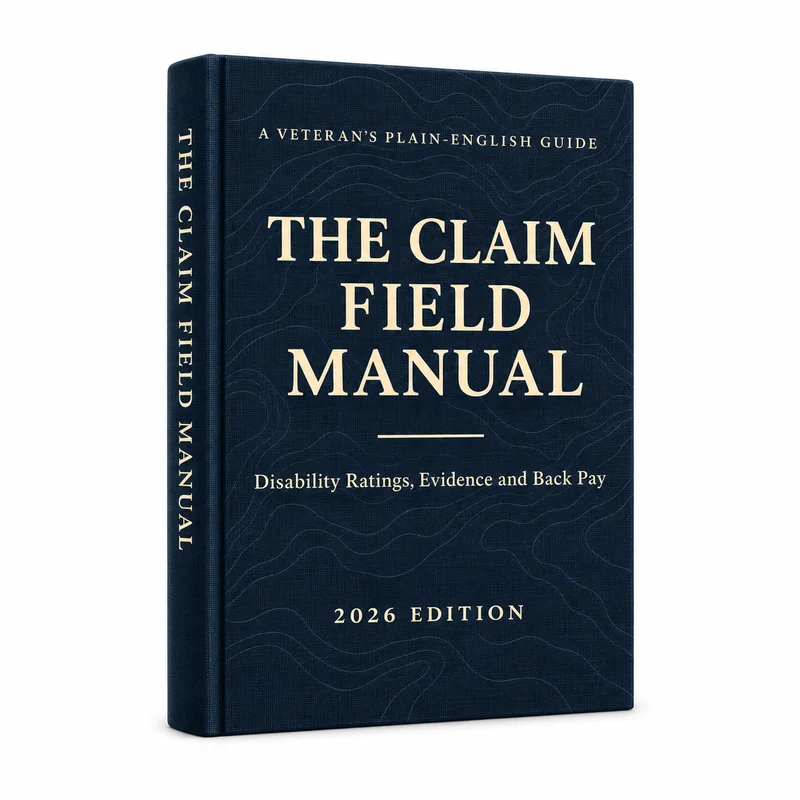
The plain-English field manual for veterans: how the VA sets a rating, why claims get denied, and how to prepare an increase, a secondary condition or a PACT Act claim yourself, with the 2026 rate table and the evidence each step needs, so you stop guessing and stop paying someone a cut of your back pay.

SO CONFUSED. was service connection granted or not?
Sometimes it seems when dealing with the VA they are waiting for an answer but never asked a question.
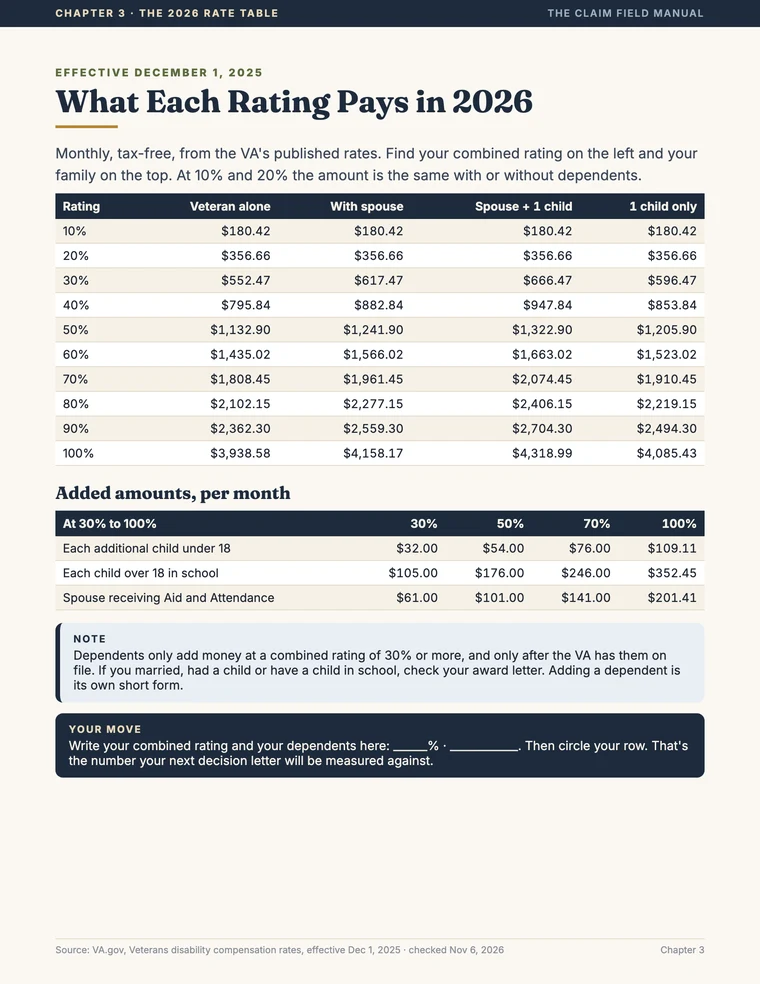
These are the VA's own published 2026 rates for a veteran with no dependents. A rating that sits a step too low isn't a rounding error. It's a smaller deposit every single month, and what moves it is usually how the claim was put together.
“Some who felt misled said they did most of the work themselves.”
NPR, on veterans who paid private claim companies · December 2025
Rates: VA.gov, Veterans disability compensation rates, effective December 1, 2025. Checked November 6, 2026.
Your effective date is usually the day the VA receives your claim, or your Intent to File. Every month before that is a month the back pay can't reach back to. Five minutes on one form protects it while you get your evidence together.
Rates go up every December with the cost of living. The rating they apply to is the part that's on you.
Decision letter, rating code sheet, C-file. You'll see what each part says, where the VA explains its reasons, and which missing piece kept the rating where it is.
Ratings come from a published schedule, 38 CFR Part 4. The manual shows how to read the criteria for your condition, so you know what the rater is looking for before you file.
Records, a personal statement, buddy statements and a medical opinion. What each one proves, and how to describe your worst days, honestly and completely.
No percentage, no contract, no one filing in your name. You prepare your claim yourself, or you walk into a free VSO already knowing what to ask.
None of this is a toughness problem. It's an evidence problem, and every one of these has a chapter of its own.
✅ Your checklist · 📄 The form it uses · 🗂️ The evidence it needs · ⚠️ The common mistake · 🔗 The official VA page
On your ownIntent to File, the right form, your evidence uploaded and your claim tracked on VA.gov. You know what you sent and why.
With a free VSOA Veterans Service Officer files for free. You show up with your records sorted and your questions written down, and the hour goes to your claim.
Open the manual, read your decision letter with it and build your checklist. If it isn't for you, send one email within 7 days and we'll refund you in full. No forms, no hard feelings.
Same table, same folder, same 6-month wait. The difference was knowing what the VA needed to see.
Mike T. ›
Dave (VFW) ›
Sharon ❤️ ›

Illustrative conversations based on what veterans share online. Individual results depend on service and medical evidence.
Read chapter 1 and file your Intent to File. Five minutes online or by phone, and your effective date is protected while you work on the rest.
Pull out your last decision letter and code sheet and go through them with the Letter Decoder. Request your C-file. Write down every condition you have and every one you never claimed.
Increase, secondary or PACT Act. Use the chapter for each one, start the Worst-Days Log, and ask the buddies who were there for a statement.
Submit it yourself on VA.gov, or take your folder to a free Veterans Service Officer. Either way, you know exactly what's in it.
One week, one folder, and a claim you understand from the first page to the last.
You were rated years agoand never re-checked it
You got a denial letterand don't know why
Your C&P exam is comingand you want to be ready
You served near burn pitsor in Vietnam
You never filed at allbecause others had it worse
A company wants a cutof your back payPhotos are illustrative.
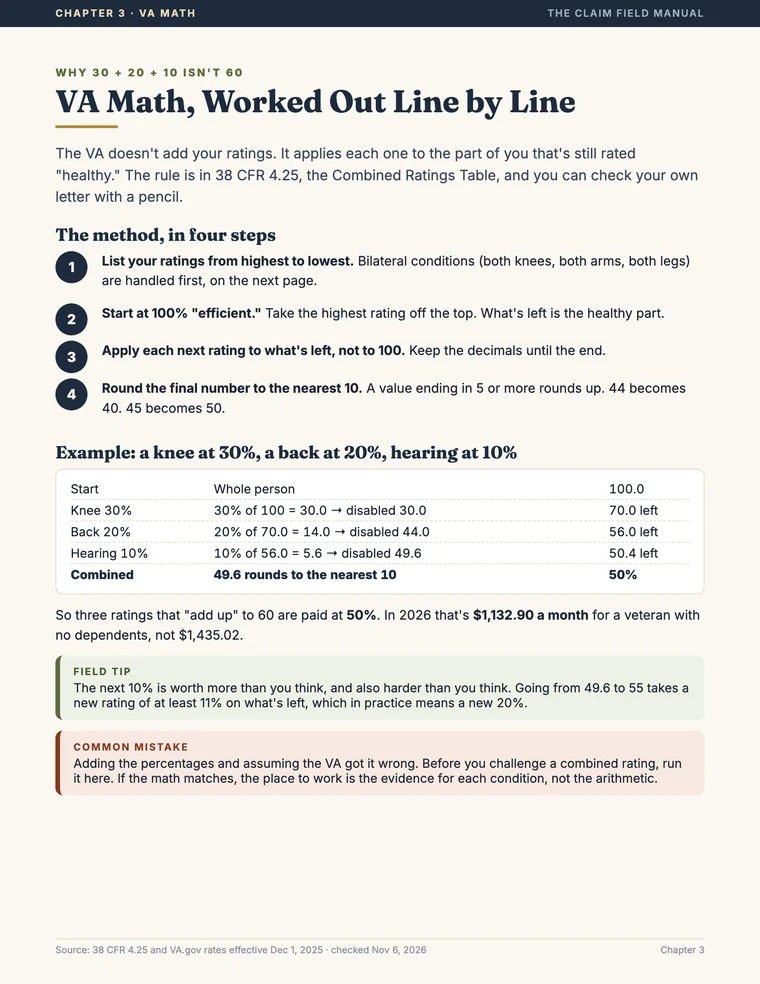
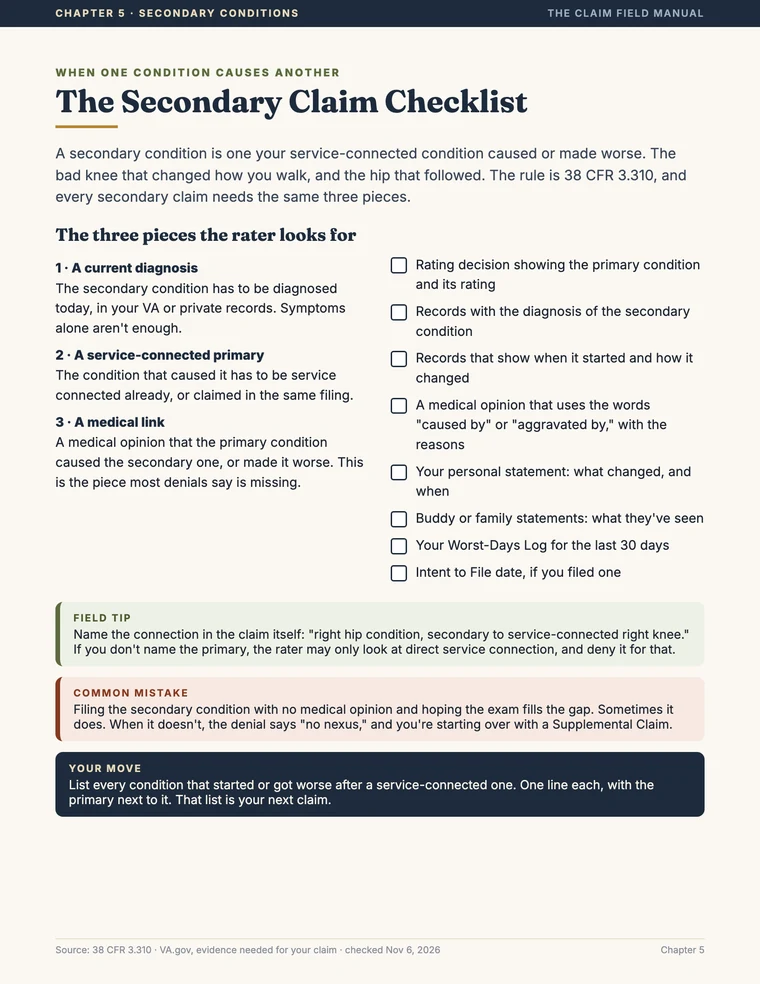
These are real pages from the manual: VA math worked out line by line, the 2026 rate table, and the evidence checklist for a secondary claim. Every number is checked against VA.gov, with the date on the page.
From the first form to the decision letter, and what to do with it.
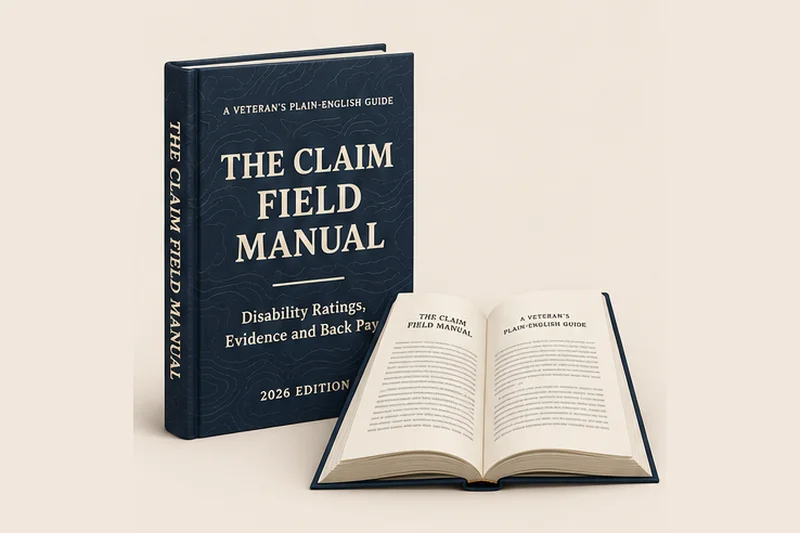
Intent to File, your letter and C-file, VA math, increases, secondary conditions, the PACT Act, your evidence, effective dates and back pay, TDIU and SMC, and what each rating unlocks. Each chapter ends with a checklist and the official VA page it comes from.

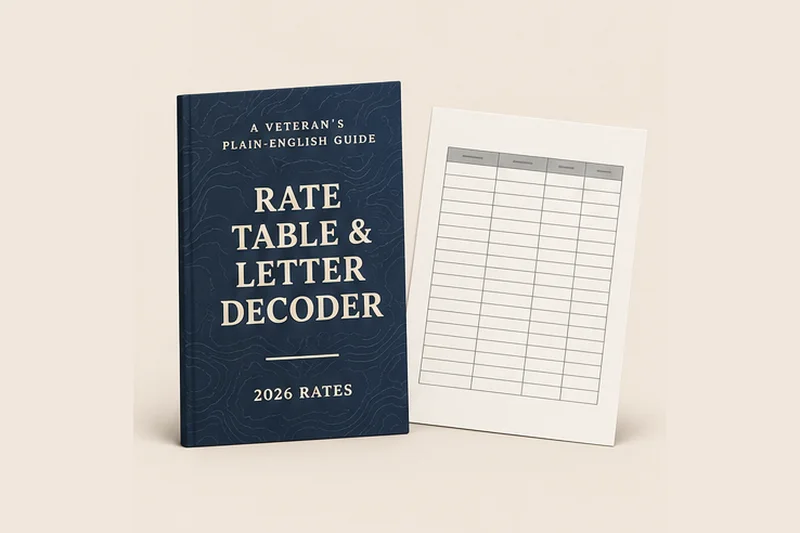
Every 2026 rate, with spouse and child rates, combined ratings worked out step by step, and a page-by-page guide to the letter the VA sent you. You'll see where your rating came from in one sitting.

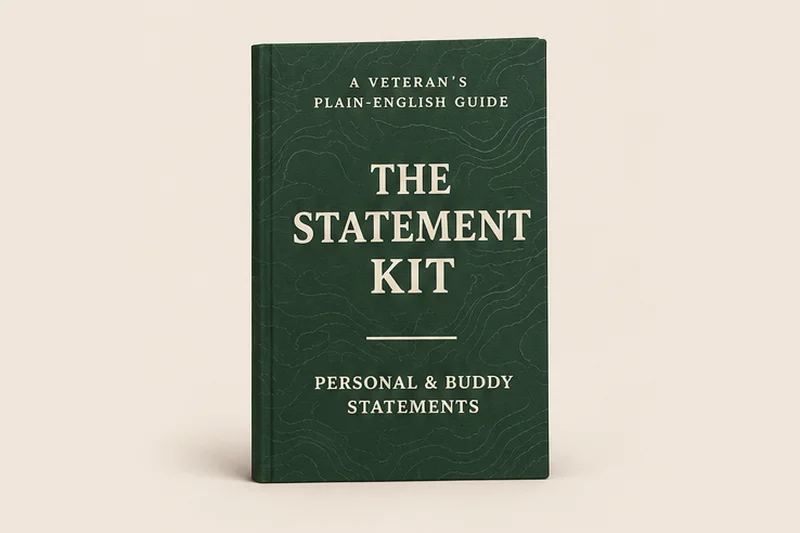
Outlines for your own statement and for the buddies who were there, with what each one should cover and the VA form it goes on. Your words, organized so the rater can follow them.

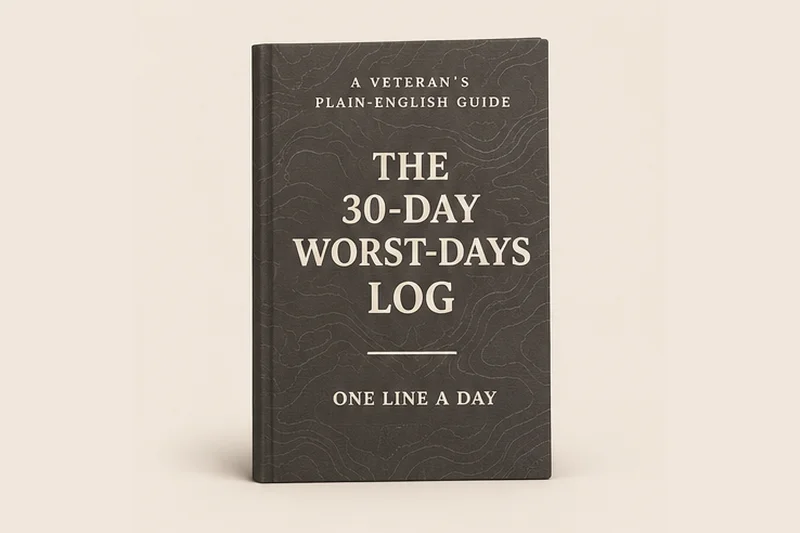
A printable log for the days that never make it into a 15-minute exam. Bring it to your doctor and to your C&P, so the bad days are on paper too.

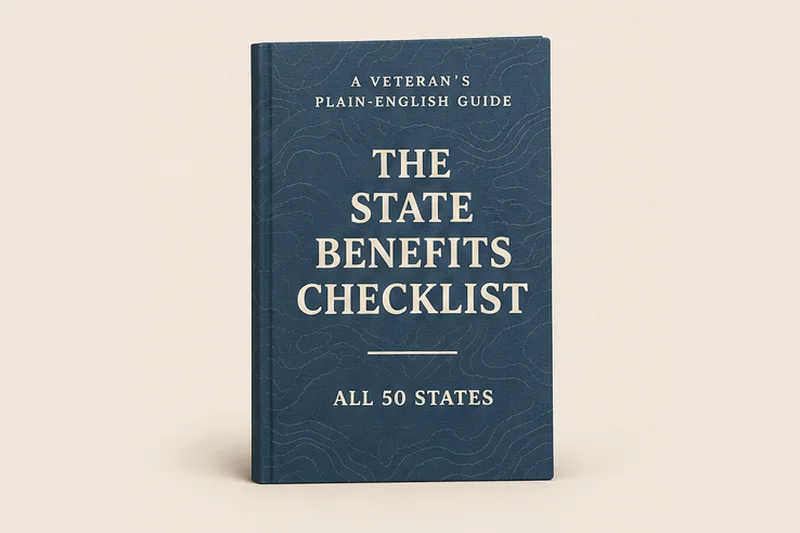
The terms and acronyms you'll see most in VA letters, in one line each, from BVA to TDIU. Plus what your rating can unlock in your state, from property tax to tuition for your kids, with the official page for each state.

Before they understood the system, in their own words.

“I waited over 20 years to file fo VA benefits and o ly because I thought I didn't deserved them”
u/triphawk07 · r/Veterans
“The whole process feels overwhelming, plus a strange sense of shame?”
u/Gerfervonbob · r/Veterans
“After reading thousands of posts about horrible C&P exams, I can’t get my thoughts together.”
u/-Comrade-L- · r/VeteransBenefits
“I tend to shut down or forget key symptoms when the doc starts talking to me about it.”
u/Boomer_- · r/VeteransBenefits
“spent 9 years filing the paperwork over and over only for nothing to happen.”
u/lonewolf13313 · r/Veterans
“I think its luck of the draw a lot of the times.”
u/Otherwise_Usual9037 · r/VeteransBenefits
“I had so much anxiety going into this process from reading all the stories about people being screwed over”
u/IrateBeggardd214 · r/VeteransBenefitsReal words from veterans on Reddit, not from buyers of this manual. Usernames as posted. Results vary.
No. The Claim Field Manual is an independent educational guide. It is not affiliated with, endorsed by, or connected to the U.S. Department of Veterans Affairs or any government agency. Every rate and rule in it is taken from VA.gov and the published rating schedule, with the date and the link.
No. The manual teaches you how the system works and what to prepare. It doesn't file anything, represent you, review your records or promise a rating. Only VA-accredited representatives can help with a specific claim.
Yes, and you should know it. Veterans Service Organizations like the VFW, DAV and American Legion help with claims for free, and VA.gov has an official finder for accredited representatives. The manual lists them. Understanding your own claim means you walk in prepared and you know what's being filed in your name.
No one can promise that, and you should be careful with anyone who does. Your rating depends on your service and your medical evidence, and the VA decides. What the manual does is show you how ratings are set and what evidence the VA looks for, so nothing is left out because nobody explained it.
Yes. Chapter 2 shows you how to read the reasons in your letter, and the manual covers the three ways to ask for a new decision and the 1-year window that protects your effective date.
There's no deadline to file for service connection, and you can ask for an increase at any time if a condition got worse. What you can't get back are the months before you file, which is why chapter 1 starts with the Intent to File.
Yes. Chapter 6 explains presumptive conditions for burn pits, Agent Orange and other exposures, and where to check the current official list.
It tells you how the exam works and how to prepare: bring your log, describe your worst days honestly and completely, and don't downplay what you live with. It never tells anyone to exaggerate. Accurate is what holds up.
Yes. It uses the rates published on VA.gov, effective December 1, 2025, and every page shows the date it was checked and the official link, so you can always confirm the current numbers.
No. It's a digital manual. You get instant access the moment you pay, on your phone, tablet or computer, and you can print any page.
No. It's educational information about how the VA disability system works. For advice on your specific claim, talk to a VA-accredited representative or a free VSO.
That's who it's written for. Plain English, one step per page, and a checklist at the end of every chapter. You can do it at the kitchen table, one chapter a night.
Yes. Checkout is secure, access arrives by email the moment you pay, and you're covered for 7 days.
Your purchase is covered for 7 days. Open the manual, read it, and if it isn't for you, send us one email and we'll refund you in full.